
Ankeny Epoxy Flooring handles concrete floor repair in Ankeny, IA, serving surrounding cities including Saylorville, Johnston, Polk City, Bondurant and Altoona. Over 20+ years we have repaired cracks, spalls, scaled surfaces and broken joints on garage, basement and commercial slabs, usually as the first step toward a coated floor, and sometimes as the whole job.
Every repair starts with a map. Before we price a floor, we walk it and mark each crack, spall, pitted area, failed patch and damaged joint, and we note which ones are cosmetic and which point to a bigger problem. That map goes into the proposal, so you know exactly what is being fixed and how.
Some slabs are not worth repairing. When a floor has heaved, sunk, broken apart or scaled across most of its face, we say so and tell you it needs replacement before anyone should coat it, rather than selling repairs that will not last.
Crack Repair
Static Hairline and Shrinkage Cracks
Most slabs develop fine shrinkage cracks as the concrete cures, and these usually stop moving once the slab has settled. We chase them open with a crack saw or grinder, clean them out, and fill them with a rigid epoxy or polyurea filler before grinding it flush with the floor.
Under a flake coating, a properly filled static crack usually disappears. Under a glossy solid color or metallic finish it may still show as a faint line, and we tell you that before the work starts.
Moving Cracks Treated as Joints
A crack that opens and closes with the seasons, or keeps growing, will tear through a rigid filler and any coating laid over it. Filling it solid only moves the crack a few inches over or makes it reappear in the finish.
We detail moving cracks as joints instead. They are filled with a flexible material that can move with the slab, and the coating is cut and finished along the line so it does not crack on its own. That is an honest repair rather than a cosmetic one that fails by spring.
Spalls, Pitting and Surface Damage
Spalled Areas and Broken Edges
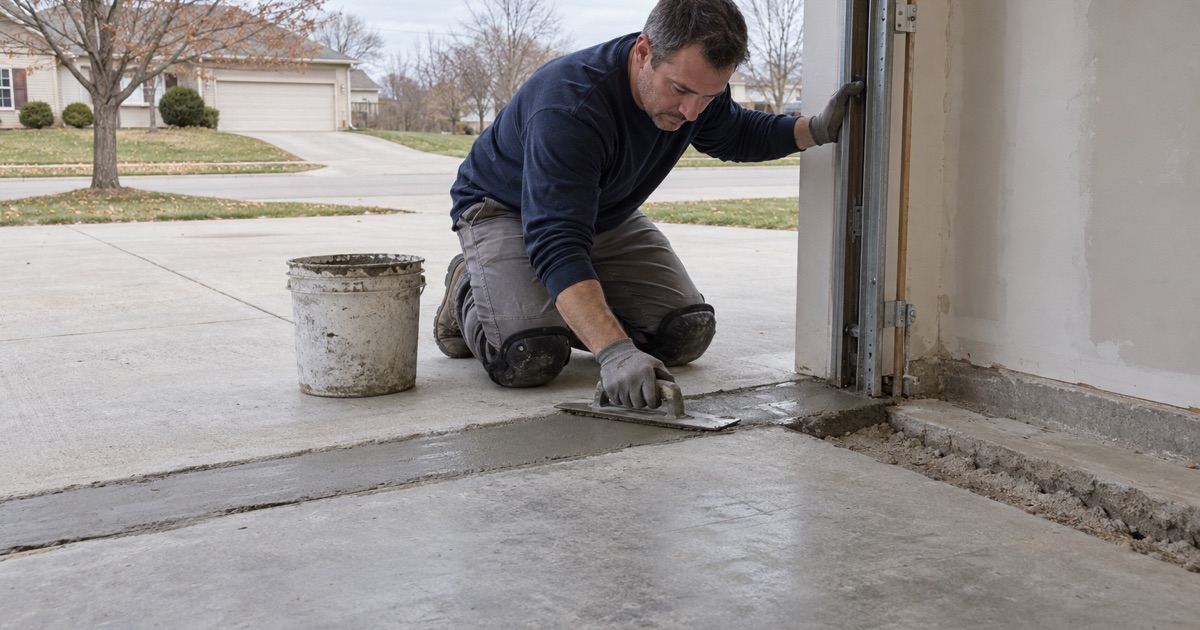
Spalls are areas where pieces of the surface have broken away, often along joint edges, around drains or where heavy loads have hit the floor. We cut back to sound concrete, clean the area and rebuild it with a repair mortar suited to the depth and the traffic.
Joint edges that have broken down under car and cart wheels get the same treatment. Rebuilding them restores a clean line, which keeps the coating from chipping along a weak edge.
Salt Scaling and Pitting
Garage slabs here take in brine and rock salt every winter, and the freeze-thaw cycles that follow break the surface into thin flakes and pits. The damage is usually worst in the first few feet inside the overhead door.
We grind scaled areas back to firm concrete and fill the pits and low spots with a repair compound before coating. If scaling has reached most of the slab, the remaining concrete may be too weak to hold a coating, and we tell you that instead of patching over it.
Old Patches and Uneven Areas
Failed Patches and Previous Repairs
Many floors carry old patches that have cracked, loosened or worn away faster than the concrete around them. A coating will not hold over a loose patch, so we sound out previous repairs and remove any that are failing.
Good existing repairs can stay. We note them on the map and blend them into the surrounding floor during grinding, so the finished coating goes over a uniform, sound surface.
High Spots, Lipped Joints and Trip Hazards
Where one section of slab sits slightly higher than the next, the edge can catch shoes, cart wheels and pallet jacks. Grinding takes down lipped joints and small high spots and removes minor trip hazards.
Grinding cannot lift a sunken section or fix a slab that has heaved badly. Those conditions usually point to soil movement or a failed base under the concrete, and they need slab work, not surface repair.
Repairs on Commercial and Shop Floors
Machine Bases and Heavy Load Areas
In shops and manufacturing spaces, the concrete under machine bases, racking feet and dock plates takes concentrated loads and vibration that the rest of the floor never sees. Spalls and cracks tend to start there, and they spread when a coating is laid over them without repair.
We cut out broken concrete around those areas and rebuild it with a high-strength repair mortar before the floor is coated. Doing that work first keeps the new floor from breaking down in the exact spots where the load concentrates.
Drains, Trenches and Slopes
Commercial kitchens, wash bays and food plants depend on floors that move water to the drains. Broken concrete around a floor drain or along a trench drain lets water pond, and ponded water works its way under a coating.
We rebuild damaged drain surrounds and correct small low spots so the floor sheds water as it was designed to. Large slope problems are a slab question rather than a repair, and we tell you when a floor needs reworking before a coating can do its job.
When the Slab Needs More Than Repair
Some signs mean a slab is past repair: large sections that have dropped or lifted, cracks wide enough to see the base, pieces that rock underfoot, or scaling that has eaten through most of the surface. In a basement, a crack that lets water in points to a drainage problem that has to be solved first.
We tell you when that is what we see, and we explain why coating over it would be wasted money. A coating follows the slab beneath it and cannot hold together concrete that is breaking apart.
- 20+ Years on Concrete
- Moisture Tested Before Pricing
- Ground, Never Acid Etched