
Ankeny Epoxy Flooring installs epoxy garage floor systems across Ankeny, IA, serving surrounding cities including Saylorville, Johnston, Polk City, Bondurant and Altoona. After more than 20 years on central Iowa concrete, the part of the job we care about most is the part you never see: how the slab was opened, what the moisture reading said, and how the floor was built up from there.
A garage floor in this part of the state works hard for five months of the year. Tires carry brine and rock salt in from the street, meltwater sits on the slab overnight, and an unheated space swings through freezing over and over. A coating that holds up to that has to be bonded to sound, ground concrete and built thick enough to take the abuse, not rolled on as a single decorative layer.
Every garage proposal we write names the product line, the number of coats and the finished thickness, along with the moisture result and any repairs. That gives you something concrete to compare between quotes, and it lets you check the finished floor against what you paid for.
What Goes Into a Garage Floor System
A 100% Solids Epoxy Base Coat
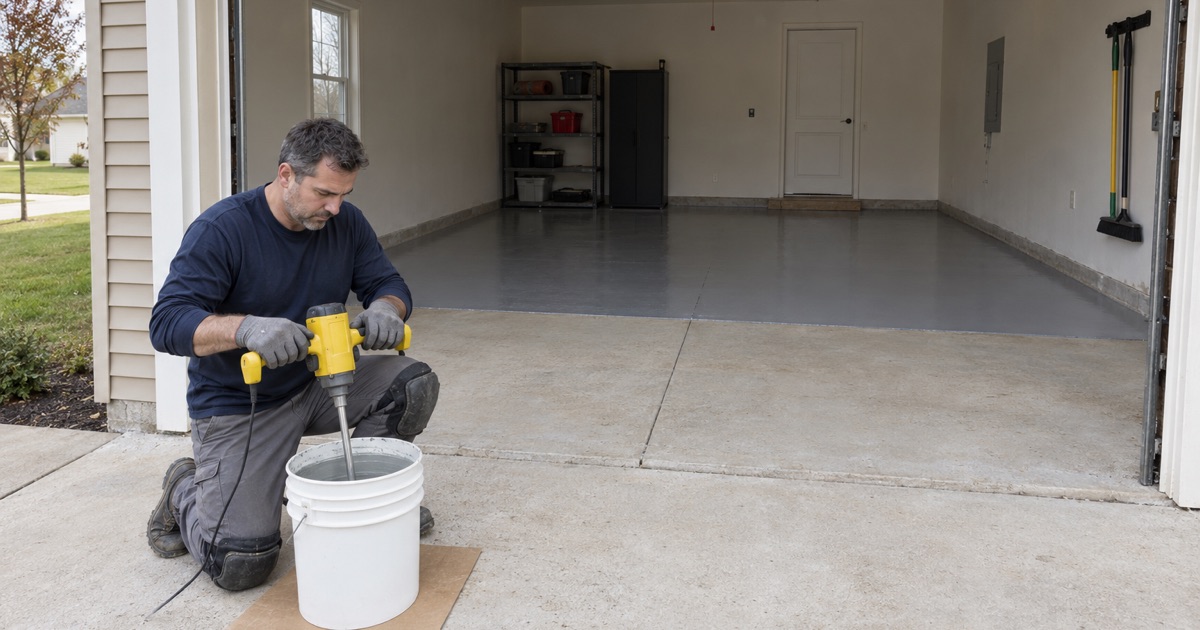
The base coat is where the system gets its bond and most of its build. We use 100% solids epoxy, which has no water or solvent to evaporate, so what goes on the slab is what stays there. That gives a thicker, denser film than the water-based epoxies sold in retail kits.
The base coat soaks into the open pores of a ground slab and locks on mechanically. On a slab with high moisture readings, a moisture-mitigation primer goes down underneath it first, so vapor rising through the concrete does not push the system off from below.
Vinyl Flake Broadcast
While the base coat is still wet, vinyl flake is broadcast across the whole floor until the surface will not take any more. That full broadcast hides the concrete, gives the floor its color and texture, and adds a layer of grip underfoot.
Once the base cures, the loose flake is scraped and vacuumed off and the surface is smoothed so the topcoat goes over an even layer. The size of the chip and the blend you choose change how busy or calm the finished floor looks, and how well it hides dust between sweeps.
Polyaspartic or Polyurea Topcoat
The topcoat is the wear surface, the layer that tires, boots and shovels actually touch. We usually finish a garage with a polyaspartic or polyurea topcoat, because it resists abrasion and chemicals, stays clear instead of yellowing in sunlight, and cures quickly enough to shorten the job.
The topcoat also sets the texture. A heavier flake broadcast or an added anti-slip aggregate gives more grip where wet tires and snowy boots come in, and we name that texture in the proposal rather than promising a nonslip floor in general terms.
Getting the Slab Ready
Diamond Grinding Instead of Acid Etching
A concrete slab has a weak, smooth skin on top, called laitance, and a coating stuck to it is only as strong as that skin. Acid etching with a store-bought wash barely scratches it and leaves salts behind. We grind every garage slab with diamond tooling, or shot blast it, to an ICRI concrete surface profile the coating maker calls for.
Grinding also takes off old sealers, paint and surface contamination, and it shows us the soft or delaminated spots that a quick look would miss. Dust is pulled into a vacuum at the grinder head, so it does not drift into the house or get rinsed toward a floor drain or the street.
Moisture Testing Even a Young Garage Slab
Ankeny has a lot of newer houses, and a newer slab is easy to assume is dry. It is not a safe assumption, because the model residential code allows a garage slab to be placed without the vapor retarder required under heated living space. We test every garage slab, whatever year the house was built.
The quick screen is the ASTM D4263 plastic sheet test. Where the numbers will decide the system, we use calcium chloride testing under ASTM F1869 or relative humidity probes under ASTM F2170, and the reading is written into the scope before the price is final.
Cracks, Spalls and Pitting
Before we price a garage, we map every crack, spall and pitted area on the slab. Static hairline cracks are routed, filled and ground flush, broken joint edges are rebuilt with repair mortar, and surface pitting from old salt damage is filled so it does not telegraph through the finish.
A crack that keeps moving will keep moving under a coating, so we detail it as a joint instead of hiding it. When the slab is heaved, badly scaled or broken into sections, we tell you it needs repair or replacement first, because no coating can make a failing slab sound.
Built for an Iowa Garage Winter
Road Salt, Brine and Calcium Chloride
From November through March, every trip in and out of the garage brings in slush loaded with rock salt and calcium chloride. On bare concrete that brine soaks in and stays, and as it dries the salt crystals form inside the pores. A sealed, nonporous garage floor keeps the brine on the surface, where a squeegee can push it out the door.
This is the main reason we choose garage systems for chemical resistance rather than looks alone. Topcoats that stand up to deicing salts and the occasional splash of antifreeze or brake fluid keep their gloss and their bond through winters that dull a cheaper film.
Freeze-Thaw Scaling Near the Door
Scaling is the flaking of the top layer of concrete, and it usually starts in the first few feet inside the overhead door. Water soaks into the surface, freezes and expands, and after enough cycles the surface lets go in thin chips. Salt makes it worse because it keeps the concrete wetter for longer.
Coating the slab stops water from soaking into the surface in the first place. If the slab already has scaling, we grind back to sound concrete and fill the damaged areas so the coating has a flat, solid base instead of a crumbling one.
Hot Tire Pickup
A tire that has been running on hot pavement in July softens a thin coating, and when the car backs out the tread can lift the film right off the slab. That is hot tire pickup, and it is one of the most common failures on retail kit floors and etched slabs.
The fix is not a different color or a better brand of kit. It is a properly ground slab, a high-build base and a hard topcoat that stays firm under a warm tire. Built that way, the floor keeps its bond in the summer as well as through the winter.
Scheduling, Cure and Odor
Cold Garages and the Dew Point
Resin cures by chemistry, and that chemistry slows sharply on a cold slab. We check the slab temperature and the dew point spread at the surface before we coat, because moisture condensing on a cold floor causes amine blush, a waxy film that weakens the bond between coats.
An unheated garage in a central Iowa winter often cannot hold the temperature a proper cure needs. When that is the case we tell you to wait for warmer weather, or we discuss a fast-curing system with a cold-weather window, rather than coat the floor anyway and hope.
Low-Odor Products for Attached Garages
Most garages here share a wall and a door with the house, so odor matters. We offer low-odor products for attached garages, which make it easier to stay home during the job and come back through the garage sooner. That is a comfort and re-entry choice, and we never present it as something Iowa law requires.
We also seal off the door into the house and run dust collection at every grinder. Between the two, the mess stays in the garage and the smell fades quickly once the topcoat cures.
Walking, Parking and Full Cure
A new garage floor reaches different milestones at different times. Foot traffic comes back first, then light storage, then parking, and the full chemical cure comes last. The exact timing depends on the products and on the slab temperature during the job.
We give you each date in writing when the floor is handed over. Parking too early is one of the few ways to damage a well-built floor, so waiting the extra day is cheap insurance on a floor meant to last many winters.
- 20+ Years on Concrete
- Moisture Tested Before Pricing
- Ground, Never Acid Etched