Ankeny Epoxy Flooring installs industrial epoxy flooring in Ankeny, IA, serving surrounding cities including Saylorville, Johnston, Polk City, Bondurant and Altoona. Industrial floors take punishment that no garage ever will: forklift wheels, dropped steel, hot water, oils, solvents and round-the-clock traffic. Over 20+ years we have learned that what keeps those floors bonded is preparation and a system thick enough for the load.
The Ankeny area mixes manufacturing plants, food processors, cold storage and the distribution parks along I-35, and each of those floors fails in a different way. A warehouse aisle wears at the joints, a machine shop floor softens under coolant, and a wash-down room breaks down under hot water and cleaners. We choose the system for the failure we are trying to prevent.
Industrial proposals from us name the product line, every layer, the finished thickness, the surface profile, the moisture results and the repair scope. Facility and maintenance managers get a specification they can review, and a floor they can measure against it.
Industrial Floor Systems
High-Build and Trowel-Applied Epoxy
For heavy traffic and impact, thin roll-on coatings are not enough. We install high-build 100% solids epoxy systems and, where needed, trowel-applied epoxy mortars that build substantial thickness and resist impact and abrasion.
These systems level out minor surface damage and create a dense, seamless floor that stands up to forklifts, pallet jacks and rolling carts. A chemical-resistant topcoat finishes the system and makes cleanup easier.
Urethane Cement for Heat and Chemicals
Urethane cement is a heavy-duty blend of resin and cement that handles hot water, steam cleaning, thermal shock and many chemicals better than standard epoxy. It is the system we usually specify for food processing, wash-down areas and floors that cycle between hot and cold.
It goes down thicker than most epoxies and can be troweled up walls into a coved base, sealing the floor-to-wall joint where water and debris would otherwise collect. That cove also gives sanitation crews one continuous surface to clean.
Chemical-Resistant Topcoats
Some plants handle acids, solvents or other aggressive chemicals that attack ordinary coatings. In those areas we specify topcoats chosen for the specific chemicals on site, including higher-resistance epoxy formulations such as novolac epoxies where the exposure calls for them.
We ask for a list of the chemicals and cleaning products the floor will see, and their concentrations and temperatures. The topcoat is matched to that list, not to a general claim of chemical resistance.
Preparing Industrial Slabs
Shot Blasting Large Areas
Large industrial floors are usually prepared by shot blasting, which fires steel shot at the surface to remove laitance, coatings and contamination and leave an even profile. It covers open areas quickly, and the dust is captured by a vacuum at the machine.
Edges and areas the blaster cannot reach are diamond ground. The prepared surface is checked against the ICRI concrete surface profile the system calls for, with thicker systems needing a deeper profile.
Joints, Cracks and Spalls
Industrial slabs are crossed by control joints that take a beating from hard forklift wheels. Broken joint edges are cut back and rebuilt with repair mortar, and joints are filled with a semi-rigid filler that supports wheels while allowing small movement.
Cracks and spalls are mapped and repaired before coating, with extra attention to areas under machine bases and dock plates. A crack that is still moving is detailed as a joint, so it does not tear through the new floor.
Moisture and Contamination
Older industrial slabs often carry oil, coolant and chemical contamination, and many were poured without a vapor retarder beneath. We test for moisture with calcium chloride kits under ASTM F1869 or relative humidity probes under ASTM F2170, and we look for oil-soaked areas during the walk-through.
High moisture calls for a moisture-mitigation primer, and contaminated concrete may need degreasing, a specialized primer or removal and patching. Those findings are written into the scope before the price is final.
Facility Types
Warehouses and Distribution Centers
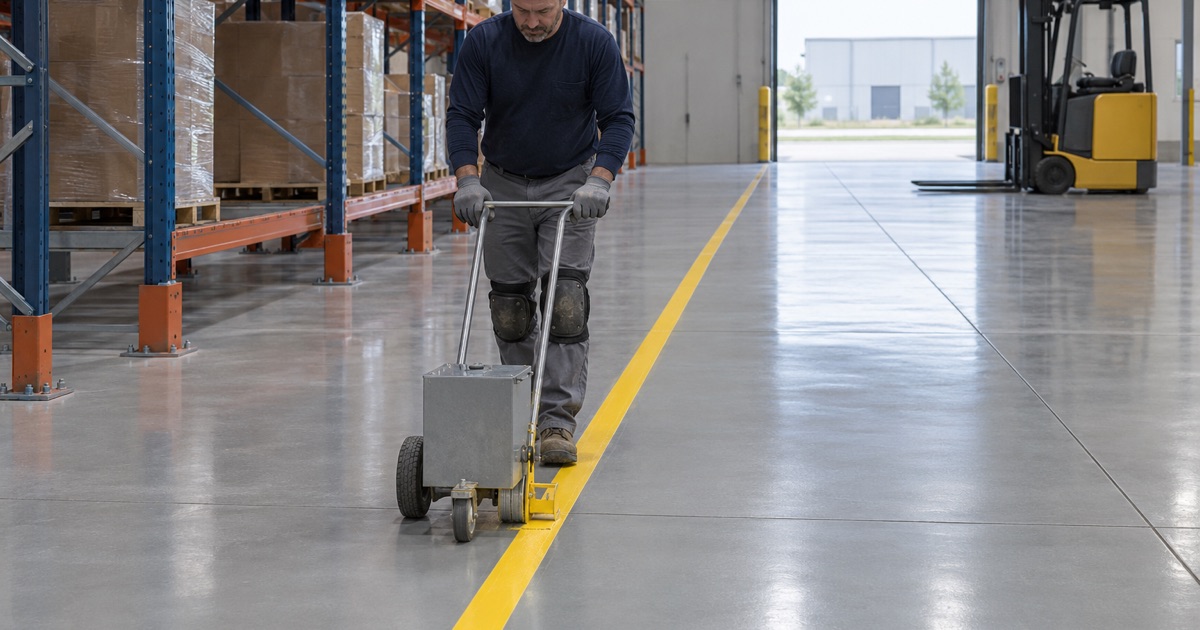
Warehouse floors need to resist forklift traffic, keep joints intact and stay bright and easy to clean. High-build epoxy systems with durable topcoats and built-in striping are the usual choice, sometimes over a densified slab in low-traffic storage zones.
We plan rack layouts, aisle widths and dock areas with you, so striping and system thickness match how each part of the building is used. Dock plates and the areas just inside overhead doors usually get extra build, because that is where heavy loads and winter salt arrive first.
Manufacturing and Machine Shops
Manufacturing floors face oil, coolant, hydraulic fluid, metal chips and dropped parts. Chemical-resistant epoxy or urethane systems with a hard topcoat protect the slab and make spills easier to clean.
Areas under machines and around work cells get extra repair and thickness where loads and vibration concentrate. Safety striping marks walkways and equipment zones.
Food Processing and Cold Storage
Food plants need seamless, nonabsorbent floors that handle daily wash-downs with hot water and sanitizers, and they need coved bases where floors meet walls. Urethane cement is our usual system in these areas.
Cold storage and freezer floors need systems designed for low temperatures and thermal cycling, and installation usually requires a planned shutdown so the slab can reach the product’s working range.
Striping, Texture and Downtime
Safety striping, walkways and hazard zones are built into the system with durable coatings rather than painted on top, so they last as long as the floor. Texture is specified by the aggregate broadcast and topcoat for each area, with more grip in wet and oily zones and smoother finishes where carts roll.
We phase industrial floors around shifts, with overnight and weekend windows when a line cannot stop. Each section has a written return-to-service time, so operations can plan around the work.
- 20+ Years on Concrete
- Moisture Tested Before Pricing
- Ground, Never Acid Etched