
Ankeny Epoxy Flooring installs flake epoxy floors in Ankeny, IA, serving surrounding cities including Saylorville, Johnston, Polk City, Bondurant and Altoona. A flake floor is the system we install most often, and after 20+ years on central Iowa concrete we have seen what makes the difference between a flake floor that lasts and one that chips and dulls in a couple of seasons.
A flake floor, sometimes called a chip or broadcast floor, is built by throwing decorative vinyl chips into a wet epoxy base coat and sealing them under a clear topcoat. The chips give the floor its color, texture and speckled look, and they add a layer of thickness and grip that a plain coating does not have.
The look comes from the flakes, but the life of the floor comes from what is under and over them. Our proposals name the base product, the chip blend and size, the broadcast density, the topcoat and the finished thickness, so you can see exactly what you are getting.
Choosing a Flake Blend
Color Blends
Vinyl flake comes in single colors and in blends of three, four or more colors mixed together. Mid-tone blends of grays, tans and blacks are the most popular for garages, because they hide dust, road grime and tire marks between cleanings.
Lighter blends brighten a basement or shop, and darker or bolder blends make a stronger statement in a showroom or finished space. We bring physical samples and lay them out on your floor, because a blend can look very different under your lighting than on a sample card.
Chip Size
Flake chips come in several sizes, from small chips that give a fine, granite-like texture to larger chips that read as a bold speckle. Larger chips cover more area and show more of each color, while smaller chips blend into a more uniform look.
Chip size also affects texture. Larger chips can leave a more pronounced surface under a single topcoat, and smaller chips make it easier to build a smoother finish. We match the chip size to how the floor will be used and how you want it to feel underfoot.
Full and Partial Broadcast
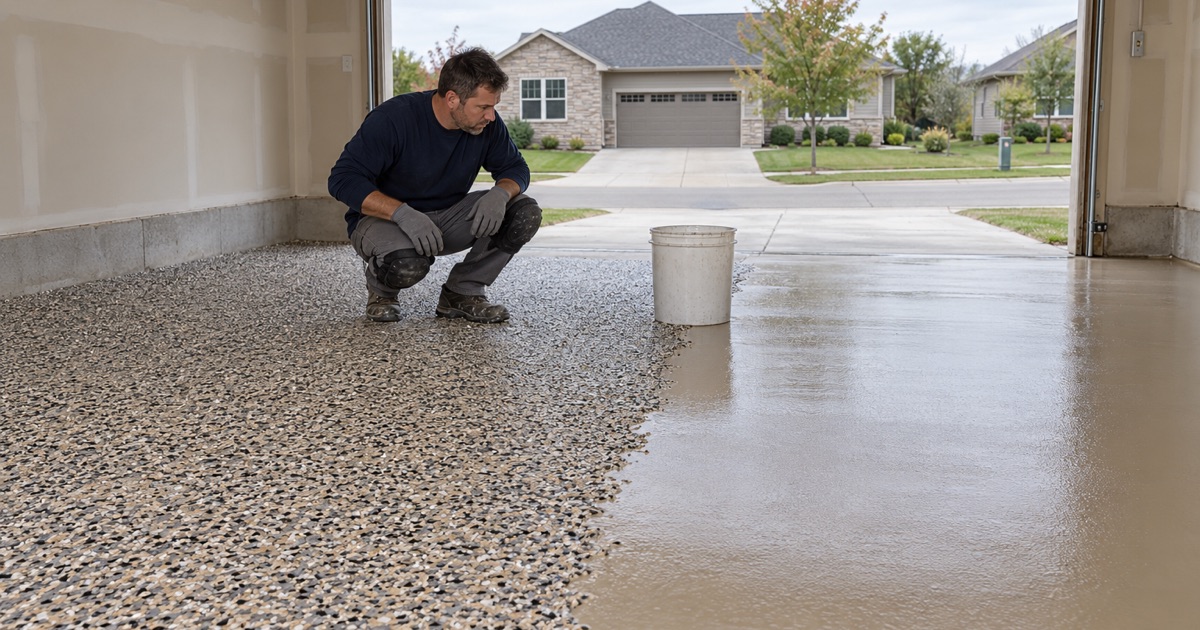
Full Broadcast to Refusal
In a full broadcast, flakes are thrown into the wet base coat until it is completely covered and cannot hold any more. That is called broadcasting to refusal. Once the base cures, the excess chips are scraped and vacuumed away.
A full broadcast hides the concrete completely, builds more thickness and gives the most texture and grip. It also hides slab imperfections and minor repairs better than any other finish, which is why it is our usual recommendation for garages and utility spaces.
Partial Broadcast
In a partial broadcast, flakes are scattered more lightly over a colored base coat, leaving the base color visible between the chips. The result is a lighter, more open speckle, often in a color that coordinates with the flake.
Partial broadcast floors are thinner and smoother, and they show dust and slab imperfections more than a full broadcast. They suit spaces where a lighter look matters more than maximum durability, such as some basements and light commercial areas.
What Goes Under the Flake
Grinding and Slab Preparation
Every flake floor starts with a diamond-ground or shot-blasted slab, never an acid etch. Grinding removes the weak surface layer, old sealers and contamination, and it opens the concrete so the base coat can bond.
We map and repair cracks, spalls and pitting before the base goes down. A flake floor hides minor repairs well, but a crack that is still moving will come back through it, so moving cracks are detailed as joints rather than filled solid.
Moisture Testing and the Base Coat
We test the slab for moisture with the ASTM D4263 plastic sheet test, calcium chloride kits under ASTM F1869 or relative humidity probes under ASTM F2170, depending on the space. The reading decides whether a standard primer is enough or a moisture-mitigation primer is needed.
The base coat is usually a 100% solids epoxy, which builds thickness and holds the flake. Its color is chosen to blend with the flake, so any small gaps in the broadcast do not stand out.
The Topcoat Over the Flake
Polyaspartic and Urethane Topcoats
The topcoat locks the flakes in place and takes the wear. We usually finish flake floors with a polyaspartic or polyurea topcoat, which resists abrasion, chemicals and road salt and stays clear rather than yellowing in sunlight.
A topcoat that is too thin or worn through is the main reason flakes come loose. We name the topcoat product and thickness in the proposal, and in heavy-use garages and shops we may add a second clear coat for extra wear.
Texture and Sheen
The number of clear coats over the flake sets the texture. One coat leaves more grip for wet tires and snowy boots, and additional coats give a smoother surface that is easier to clean and gentler on bare feet in a basement.
Sheen can range from high gloss to satin. A satin finish hides scratches and dust better, and a gloss finish makes the colors in the flake stand out. We set both texture and sheen by the products used, not by a general promise of a nonslip floor.
Where Flake Floors Work Best
Flake floors are a natural fit for garages, where they stand up to the brine and rock salt carried in on tires from November through March. They also work well in basements, laundry rooms, workshops, and commercial spaces such as break rooms, restrooms and service areas.
In an attached garage or basement, we offer low-odor products as a comfort choice and capture grinding dust at the machine, so the job stays in the space being coated.
- 20+ Years on Concrete
- Moisture Tested Before Pricing
- Ground, Never Acid Etched