Ankeny Epoxy Flooring installs polyaspartic floor coating systems in Ankeny, IA, serving surrounding cities including Saylorville, Johnston, Polk City, Bondurant and Altoona. Polyaspartic is the fast-curing, sunlight-stable coating that has changed how garage and shop floors are finished, and after 20+ years of coating concrete we know where it earns its price and where an epoxy base still belongs underneath it.
Most of the polyaspartic we install goes on as the topcoat of a multi-layer floor, over an epoxy base and a flake broadcast. Some floors use it top to bottom. Either way, the coating only performs if the slab under it was ground properly and tested for moisture, because a fast cure does not forgive poor preparation.
The proposal for a polyaspartic floor names the exact product line, each coat in the system and the finished thickness, plus the moisture reading and the repairs. That way the speed of the install never hides what went into the floor.
What Polyaspartic Is
An Aliphatic Polyurea Built to Be Rolled
Polyaspartic coatings belong to the polyurea family. Pure polyurea reacts in seconds and has to be sprayed with plural-component equipment, so chemists slowed the reaction to make a version that a crew can roll and squeegee across a floor.
The result keeps much of polyurea’s toughness and chemical resistance in a coating that can be placed by hand. Because the chemistry is aliphatic, it does not depend on the aromatic resins that make many epoxies yellow in sunlight.
Holding Color Under Sunlight
Ultraviolet light breaks down aromatic epoxy over time, and the floor slowly turns amber, most visibly near an open garage door or a bright window. A polyaspartic topcoat holds its clarity and color under the same exposure.
That matters most on light chip blends, white or pale metallics, and storefront floors that catch the afternoon sun. A clear polyaspartic layer over the color coat keeps the floor looking the way it did the day it was finished.
Fast Cure and Short Working Time
Polyaspartic cures quickly, often allowing foot traffic within hours and vehicles much sooner than many epoxies. That speed is a real advantage when a family needs the garage back or a business needs a floor open again.
The tradeoff is a short working time once the material is mixed. Crews have to work in smaller batches and move fast, and an installer without experience in that window can leave roller marks, lap lines or bubbles locked into the finish.
Polyaspartic Compared With Epoxy
Where a 100% Solids Epoxy Base Still Wins
Epoxy is slower to cure, and that slowness is useful at the bottom of the system. A 100% solids epoxy base has time to soak into the open pores of a ground slab, and it builds thickness at a lower cost per layer.
For that reason many of our garage and basement floors use epoxy as the base and broadcast coat, with polyaspartic on top. The epoxy does the bonding and building, and the polyaspartic does the wearing and the weathering.
Full Polyaspartic Systems
Some floors are built with polyaspartic from the primer up. A full polyaspartic system can go down and return to service faster, and it can cure on a cooler slab than most epoxies will tolerate.
The tradeoffs are a higher material cost and less forgiveness on a porous or damp slab. We recommend a full polyaspartic build when the schedule or the temperature genuinely calls for it, not as a default upsell.
The Truth About One-Day Floors
A one-day floor is possible with polyaspartic, and on a clean, sound, dry slab it can be a good choice. The risk is that the promise of one day becomes the reason to skip the repairs, the moisture test or a second coat.
We schedule the floor the slab needs. If your floor can be done in a day, we will say so, and if it needs crack repair, a primer for moisture or an extra coat for wear, the schedule will show it.
Installing Polyaspartic the Right Way
Grinding to a Proper Profile
Polyaspartic wets out a surface quickly and grips what it touches, which is exactly why the surface has to be right. We diamond grind or shot blast every slab to the concrete surface profile the product calls for, never relying on an acid etch.
Grinding opens the pores, removes the weak top layer and takes off old sealers and coatings. Dust is collected at the grinder head by a vacuum, so the floor is clean when the first coat goes down and nothing is washed toward a drain.
Moisture Testing Before Coating
A polyaspartic floor is not a moisture barrier. Vapor moving up through the slab can cause blisters and bond loss in a polyaspartic system just as it can in an epoxy, and a fast cure can trap that moisture in quickly.
We test the slab with calcium chloride kits under ASTM F1869 or relative humidity probes under ASTM F2170, and the result goes into the written scope. When the readings are high, a moisture-mitigation epoxy primer goes down under the polyaspartic.
Temperature, Humidity and the Dew Point
Polyaspartic tolerates a cooler slab than most epoxies, but it is sensitive to moisture in the air. High humidity can shorten the working time further and cause bubbling or a hazy surface.
On every install day we measure the slab temperature, the air temperature and the dew point spread at the surface. If a cold garage or a humid basement cannot stay in the window, we move the date instead of coating into conditions that will show in the finish.
Where Polyaspartic Fits Best
Garages That Take Winter Salt
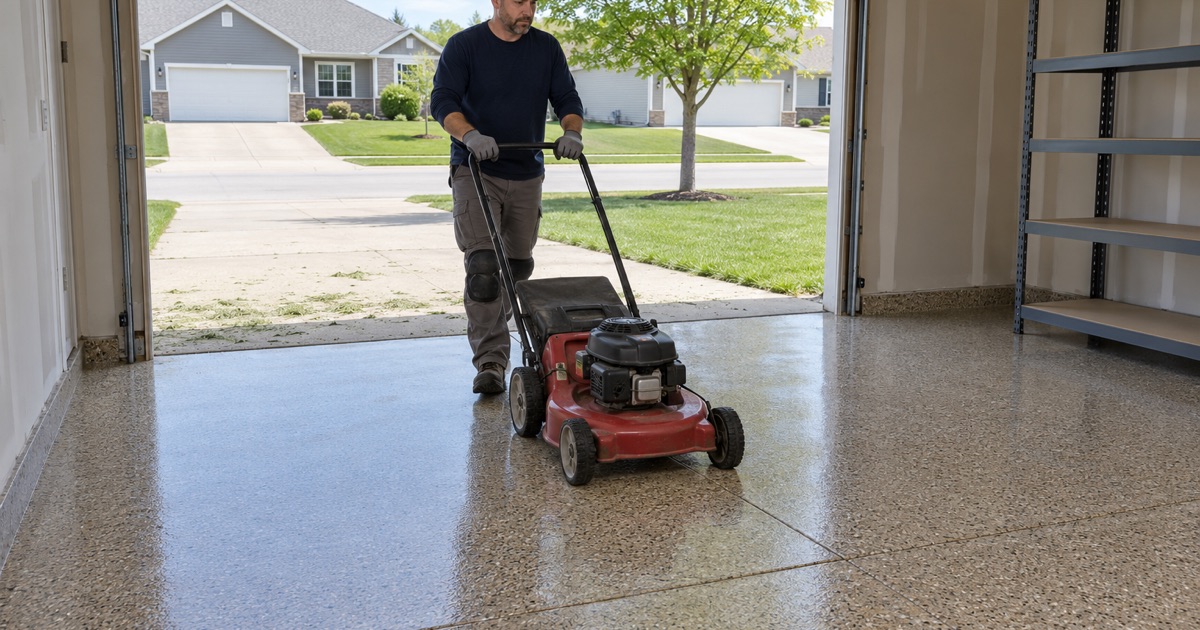
A polyaspartic topcoat stands up to the rock salt, brine and calcium chloride that come in on tires from November through March. It resists the chemicals, keeps its gloss, and lets slush be squeegeed out without soaking into the slab.
Its resistance to abrasion also helps where tires turn on the floor and snow shovels scrape across it. Over a full flake broadcast, it gives a garage floor that handles central Iowa winters and still looks clean in spring.
Basements and Attached Spaces
In basements and attached garages, the speed of a polyaspartic install means less time with the space out of use. Some polyaspartics carry a noticeable odor during application, so we offer low-odor options where the smell would reach the house.
That is a comfort and re-entry choice rather than a legal one. In a basement we also check the sump pit and drain tile first, because a coating, however tough, does not stop water from coming through the slab.
Shops, Showrooms and Commercial Entries
Auto repair bays, workshops, showrooms and retail entries all benefit from a topcoat that cures fast and holds up to chemicals and sunlight. A business can often reopen a coated section the next morning.
We phase commercial polyaspartic work around shifts, with overnight and weekend windows when a space cannot close. Texture is set by the broadcast and an anti-slip additive in the topcoat, and we specify it for the traffic and spills each area actually sees.
- 20+ Years on Concrete
- Moisture Tested Before Pricing
- Ground, Never Acid Etched