
Ankeny Epoxy Flooring installs ESD flooring in Ankeny, IA, serving surrounding cities including Saylorville, Johnston, Polk City, Bondurant and Altoona. ESD stands for electrostatic discharge, and an ESD floor is built to carry static charge safely to ground before it can jump to a sensitive component, a piece of equipment or a flammable atmosphere. With 20+ years of preparing and coating concrete, we treat an ESD floor as an engineered system rather than a decorative one.
Static builds up as people walk, carts roll and materials move. In most buildings it is a minor annoyance, but in electronics assembly, data and server rooms, laboratories, and some medical and manufacturing spaces, a discharge too small to feel can damage parts or disrupt equipment. The floor is one of the most important surfaces in a static control program because everything and everyone touches it.
Our ESD proposals spell out the resistance range the floor is designed for, the grounding layout, the product line, each coat and the finished thickness, along with the test method we will use to verify the floor. That gives your quality or facilities team something measurable to sign off on.
How an ESD Floor Works
Conductive Pathways Through the Coating
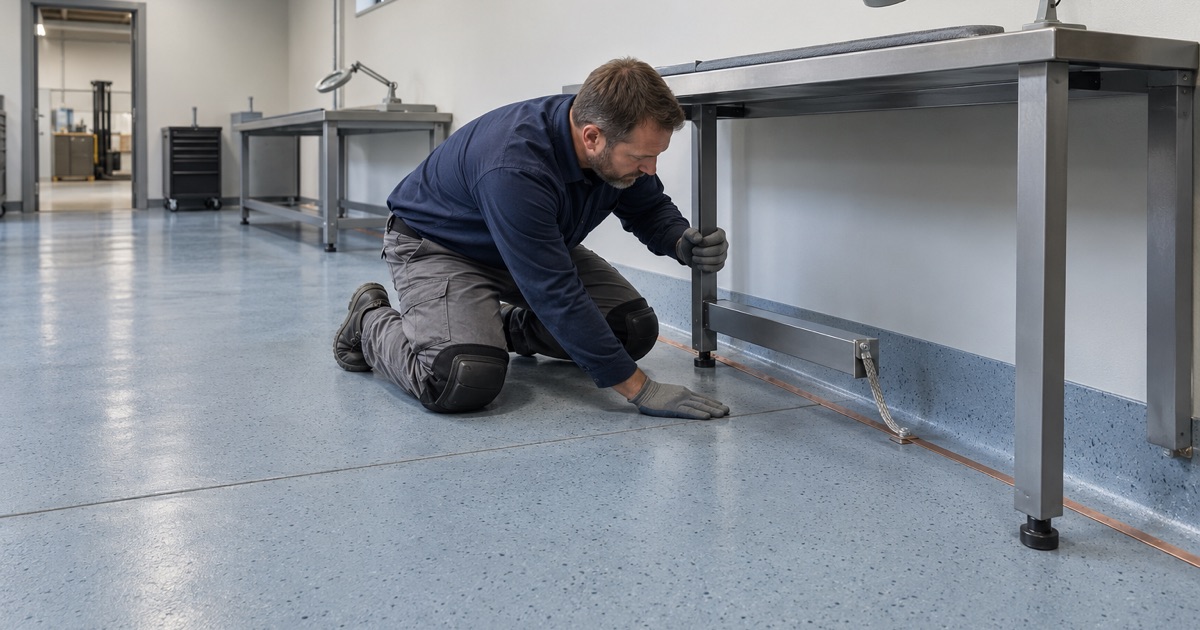
An ESD epoxy system contains conductive materials, such as carbon fibers or other conductive fillers, mixed into the coating so a charge can travel through it. Under the visible topcoat sits a conductive primer or layer that spreads the charge across the floor.
That layer is tied to copper grounding strips or tape laid on the slab and connected to the building’s ground. A charge picked up by a person or cart moves down through the topcoat, into the conductive layer and out to ground at a controlled rate.
Static-Dissipative and Conductive Ranges
ESD floors are designed to a resistance range measured in ohms. Static-dissipative floors sit in a higher range, commonly cited as about a million to a billion ohms, and release charge slowly. Conductive floors sit in a lower range and drain charge faster.
Which range you need depends on what is being protected and on your program’s requirements. Many electronics facilities build their programs around ANSI/ESD S20.20, and the floor range should match what that program, your customer or your equipment maker specifies.
Why Footwear and Grounding Matter
A floor can only drain the charge that reaches it. People need ESD footwear or heel grounders to make contact with the floor, and carts, chairs and racks need conductive wheels or drag chains.
We point this out because an ESD floor installed without the rest of the program will test well and still not protect anything. The floor, the footwear and the grounding work together as one system.
Preparing the Slab for an ESD System
Grinding and Repair
An ESD system needs a clean, sound slab with a profile the primer can grip. We diamond grind or shot blast the concrete, remove old coatings and adhesives, and repair cracks and spalls before any conductive layer goes down.
Grinding dust is captured at the machine with a vacuum, which matters in electronics and lab environments where dust is unwelcome. We clean the slab thoroughly before priming, because contamination can affect both the bond and the conductivity of the system.
Moisture Testing
Moisture coming through a slab can cause blisters and bond failure in an ESD system, and it can also change how the floor tests. We test with calcium chloride kits under ASTM F1869 or relative humidity probes under ASTM F2170 before pricing the job.
Where readings are high, a moisture-mitigation primer goes down first, and the ESD layers are built on top of it. We explain at the start that moisture is the first exclusion in most coating warranties.
Planning the Grounding Layout
The grounding strips and connection points are planned before installation. Their spacing and location depend on the size of the floor, the system’s requirements and where building ground is available.
We lay out the grounding with your facilities or electrical team, so connections reach a verified ground. The layout is recorded in the closeout documents, which helps with future testing and repairs.
Testing and Verifying the Floor
Resistance Testing After Installation
After the system cures, we test the floor’s resistance at multiple points using the method in ANSI/ESD STM7.1, measuring both point-to-point resistance across the floor and resistance from the surface to ground. The readings are compared with the range the floor was designed for.
The results are recorded and handed over with the floor. If any area reads outside the range, it is investigated and corrected before we close out the job.
Ongoing Testing and Maintenance
An ESD floor has to keep testing in range for the life of the program. Cleaning products, waxes and polishes can leave an insulating film that raises resistance, so the floor should be cleaned only with products approved for ESD surfaces.
We recommend regular resistance checks as part of your ESD program. Worn or damaged areas can often be repaired and retested without replacing the entire floor.
Where ESD Flooring Is Used
ESD floors are used in electronics assembly and repair, server and data rooms, telecom spaces, laboratories, and some medical and pharmaceutical areas. They also appear in some manufacturing and storage areas where static could ignite flammable vapors or dust, where the conductive range is usually required.
We phase ESD installations around production schedules, with overnight and weekend windows when a line or lab cannot stop. Because the floor has to be tested before it is put back into service, we plan the testing time into the schedule from the start.
- 20+ Years on Concrete
- Moisture Tested Before Pricing
- Ground, Never Acid Etched